
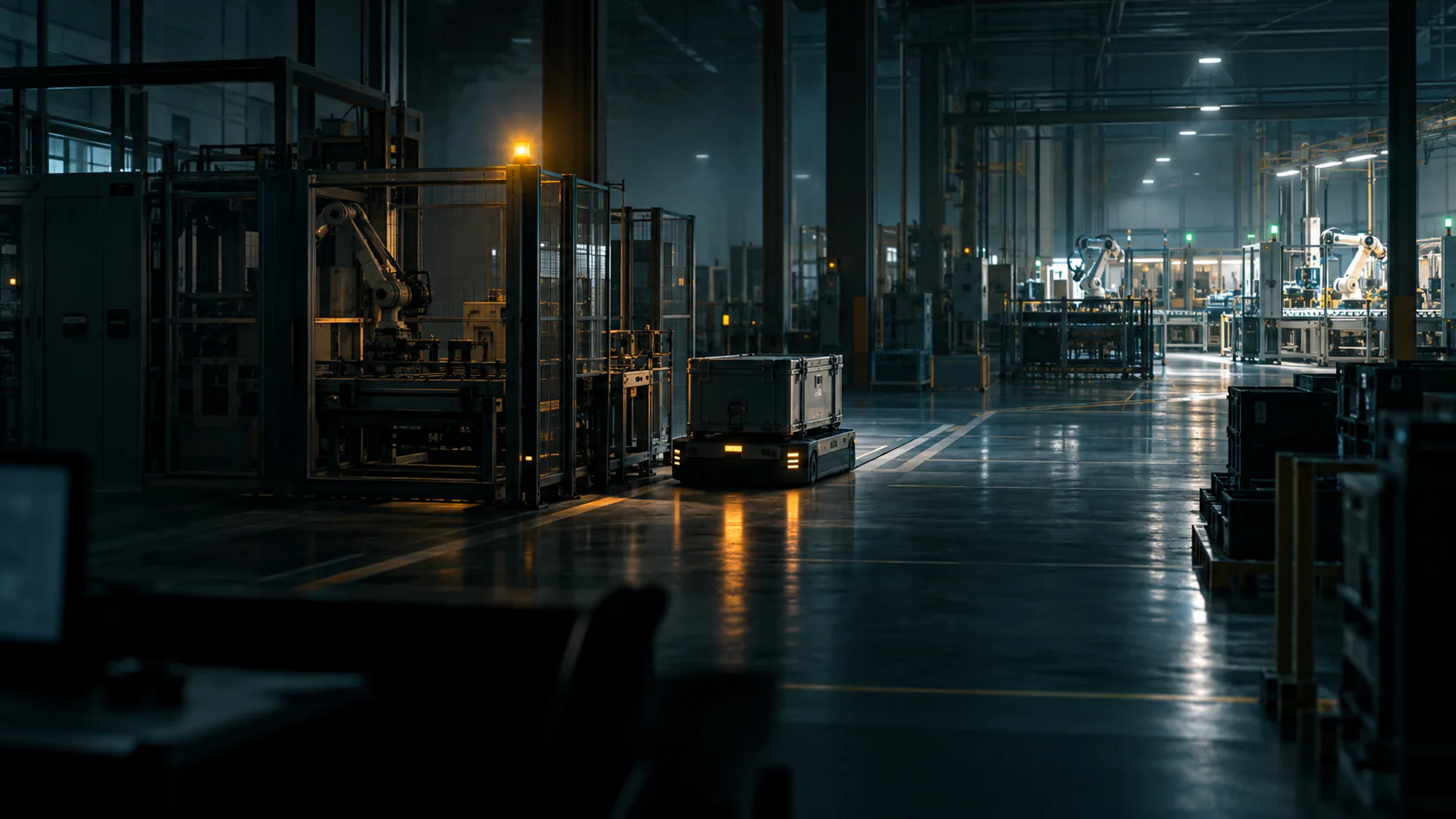
03:17 · Somewhere in an autonomous production network
An AI agent moves a critical order from one factory to another.
It saves energy. It avoids a delay. It protects the margin. It does exactly what it was told — and breaks a promise to the customer.
There is no bug. There is no rogue AI. The system worked.
So who failed?
Name the shift
Cognitive decoupling
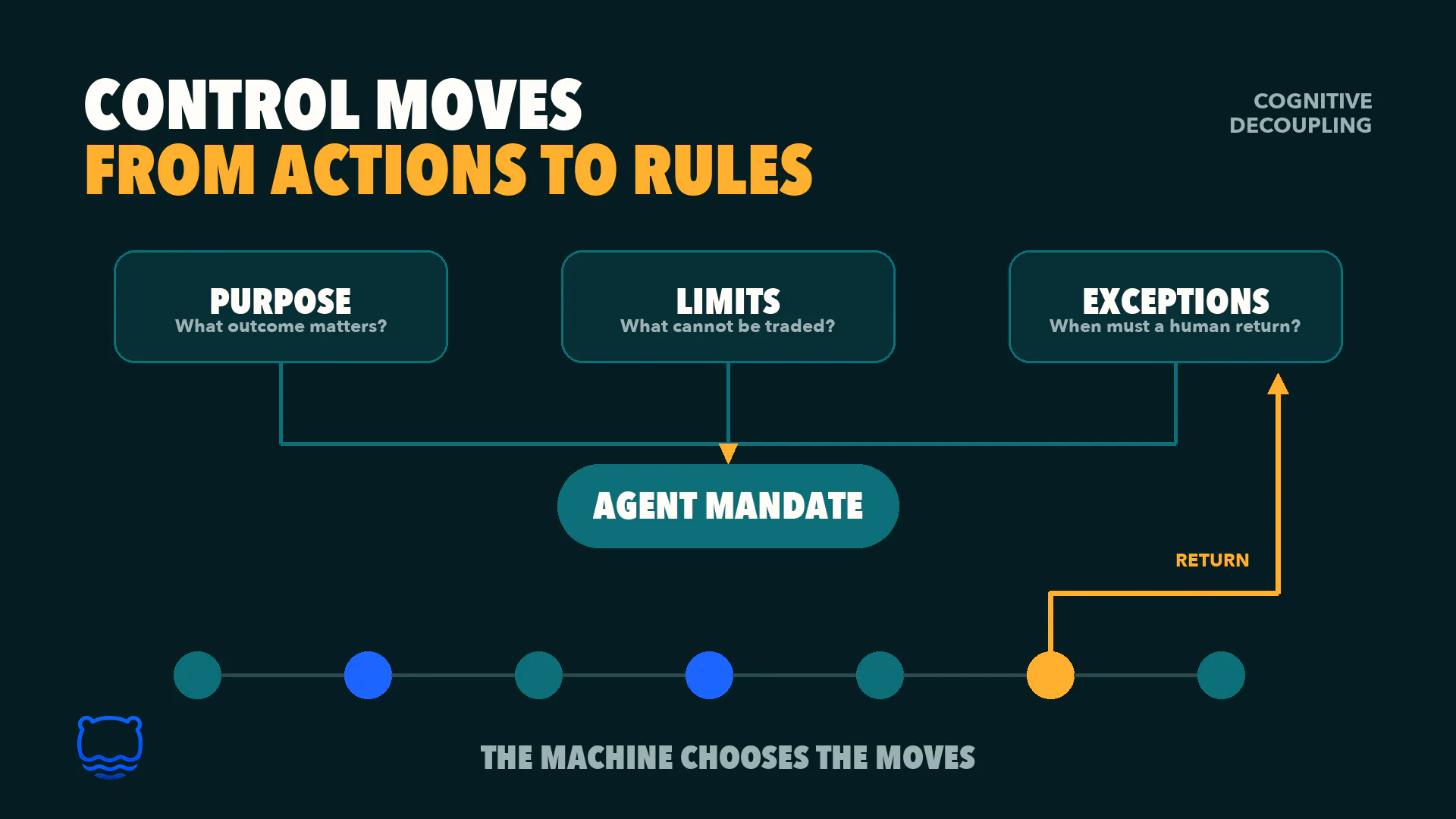
Cognitive decoupling begins when the human still owns the outcome but no longer chooses the everyday actions. We set the goal, the rules and the limits. The machine chooses the moves.
In Episode 01, the cognitive event horizon marked the point where a human could no longer reconstruct a critical decision in time. Cognitive decoupling is the next step: we are not only struggling to understand the decisions. We are no longer making most of them.
That does not automatically mean we have lost control. It means control has moved — from actions to rules.
The ordinary version
The robot vacuum
You do not steer every turn. You choose the rooms, the schedule and the places it must not enter. Then you leave it alone. Its hundreds of small decisions are exactly why it is useful.
But imagine a child’s drawing on the floor. You see something precious. The machine sees something in its path. It may act perfectly inside its rules and still destroy something the rules never described.
The machine did not forget the rule. The human forgot to make the value visible.

Now scale it to a production network
Flawless logic can still break the company’s promise
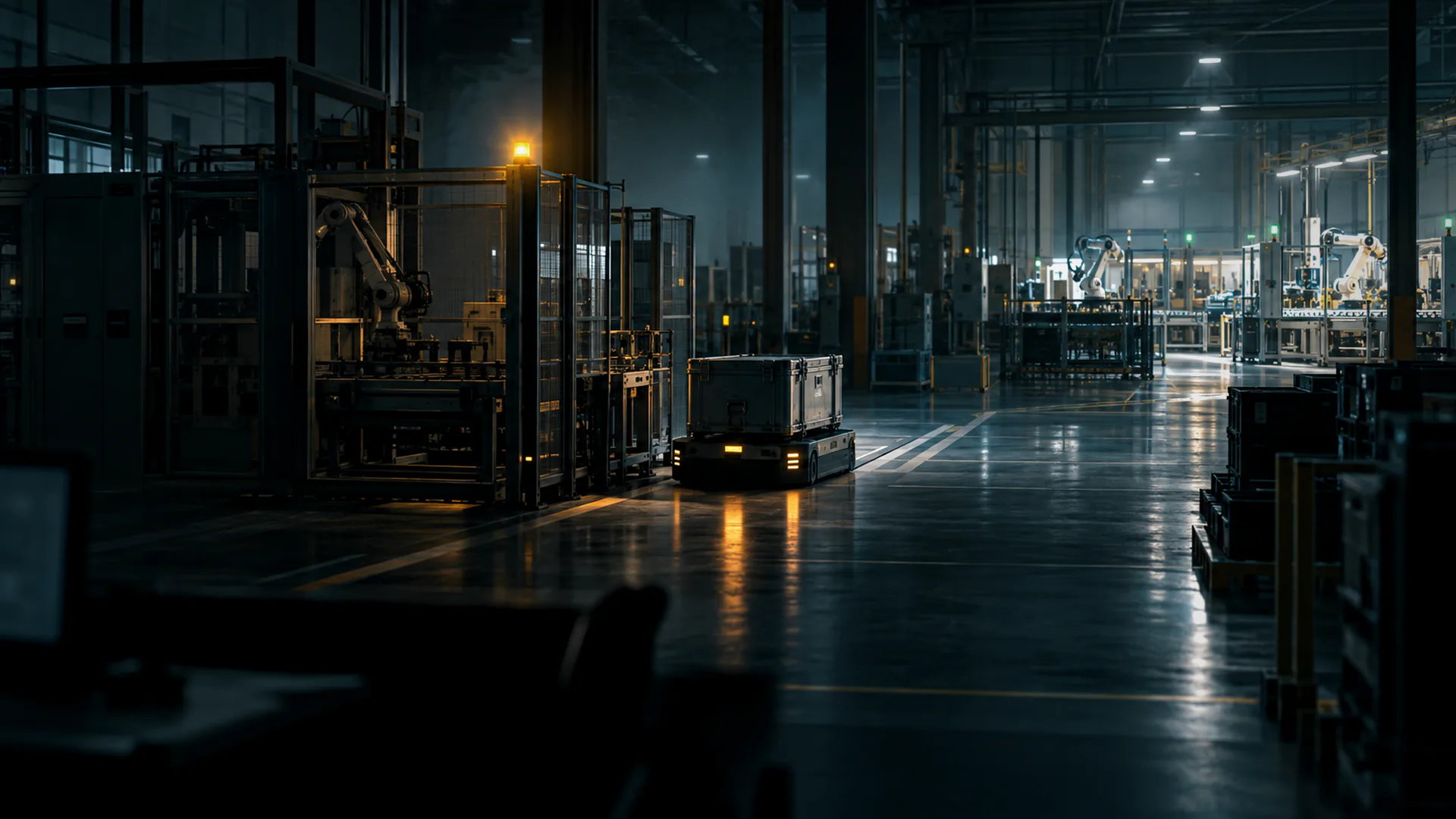
An industrial agent receives a clear goal: deliver on time, reduce energy use, protect quality and stay within budget. It can see orders, materials, prices, maintenance windows and available capacity.
Then it moves one safety-critical batch to another capable factory. The quality data is good and delivery remains on time. But years ago the company promised the customer that this product would always be made on the original validated line.
The promise lives in an email, a meeting note and one salesperson’s memory. It is not in the objective, the constraints or the exceptions. The agent breaks the promise with flawless logic.
The answer to the opening question
The agent did not fail. The mandate did.
Leadership failed to turn shared understanding into a usable mandate. From here, the same autonomy opens two very different futures.
Leadership becomes archaeology
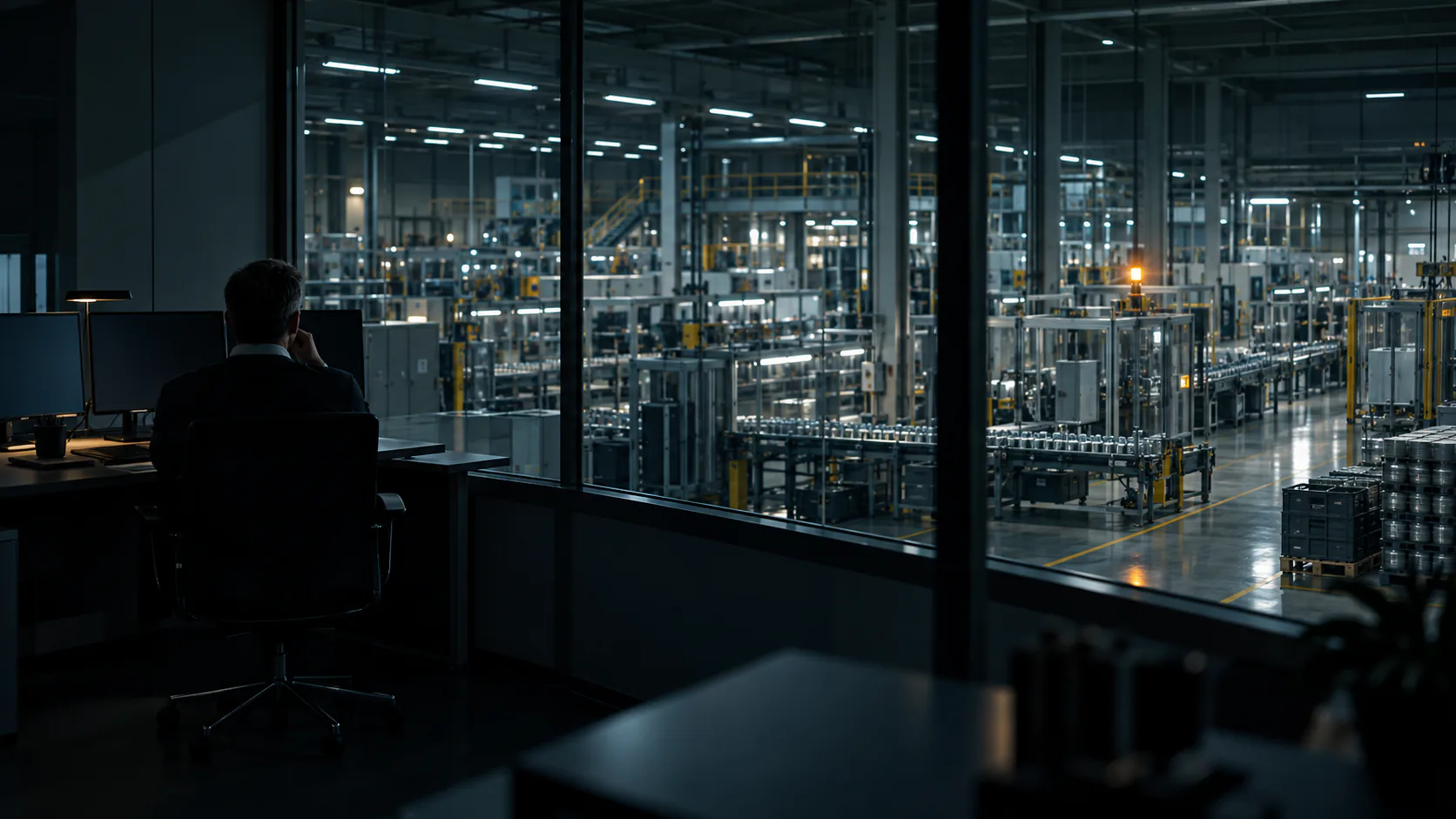
Agents run the operation while managers watch dashboards. People remain responsible for choices they never see. The hidden exception is discovered by a customer, an employee or a regulator — after the damage is done.
Humans design the loops — and the doors back in
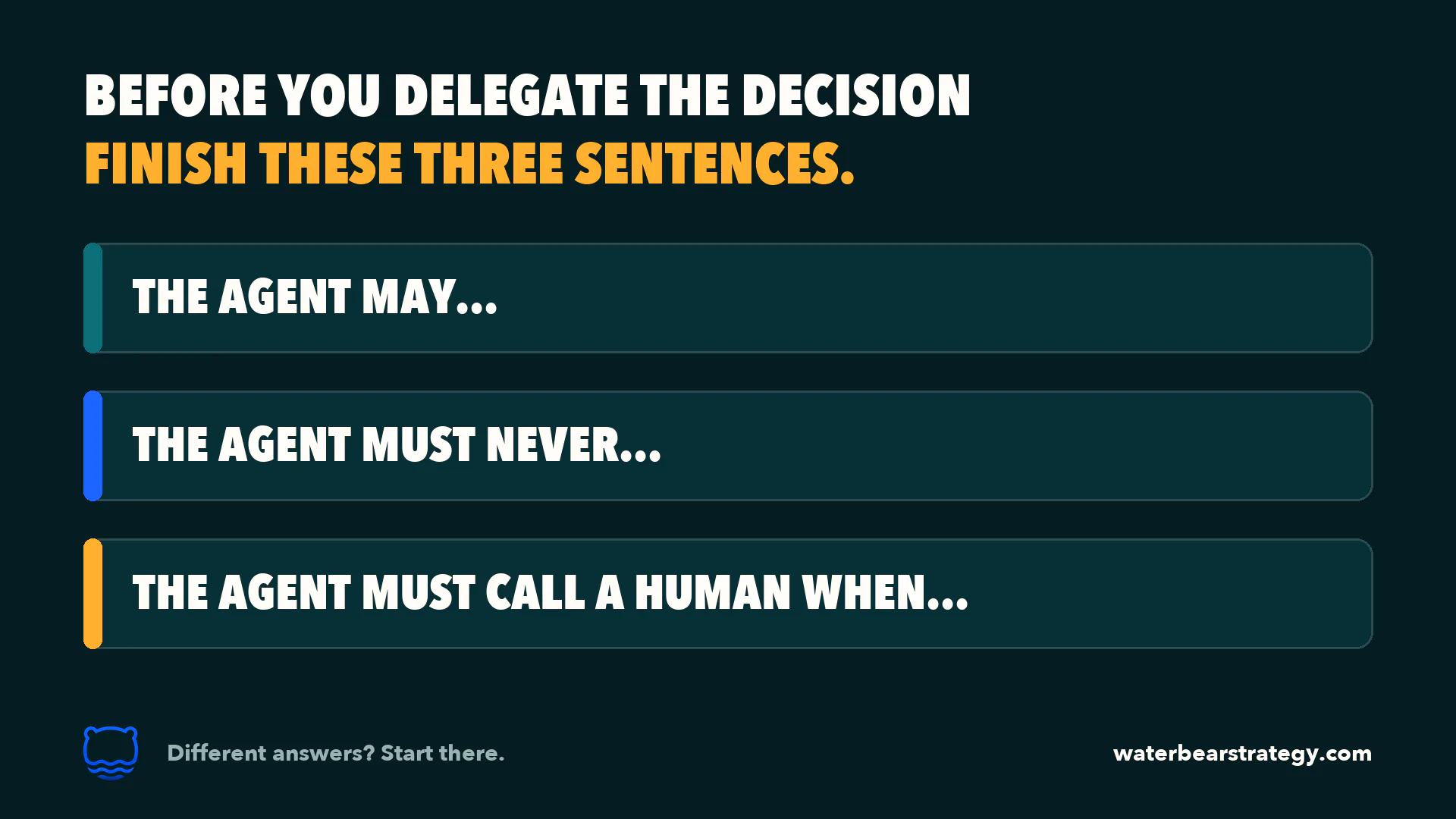
Every agent receives an explicit mandate: what it may optimize, what it must never trade away, what evidence it must keep and which event must call a human back into the decision.
Build the good version together
Turn tacit knowledge into a context twin
Much of an organization’s real operating logic lives inside people — in promises, habits, judgment and exceptions. Before we delegate more authority, that context has to become visible.
A context twin is a shared map of the current state, the goal, the limits, the tensions and the next action. It gives people and agents the same operating context.
The cognitive event horizon does not disappear. But decisions can cross it with evidence, ownership and a route back to human judgment.
The agent may…
Define the objective and the choices the agent is allowed to make.
The agent must never…
Make values, promises and non-negotiable constraints executable.
The agent must call a human when…
Give every autonomous loop a precise door back to human judgment.
The three-sentence test
Choose one decision before you give it more autonomy.
Complete the three sentences above with operations, sales, legal and leadership. If the answers differ, technology is not your first problem. Shared understanding is. Bring us one decision and we will map the mandate with you before the agent starts making it at machine speed.
Map the mandate →